 United States Verdi, Falstaff: Soloists, Chorus and Orchestra of LA Opera / James Conlon (conductor). Dorothy Chandler Pavilion, Los Angeles, 18.4.2026. (JRo)
Is there any comedy, no matter what the form, funnier and more heart-warming than Verdi’s Falstaff? In opera, Mozart and Rossini wrote their share of gems, and in silent film there’s Chaplin and Keaton. There are the Marx Brothers, Lucille Ball, Woody Allen and Bugs Bunny, to name a few. But I propose that Verdi, in bringing Sir John Falstaff to vivid life, reigns supreme or, at the very least, is on a par with these comedic masters.
The characters and situations are often hilarious, but it is in the orchestra, first and foremost, where the humor resides. With its quicksilver moods, the sparkling score flashes by at a pace that takes the breath away – one moment bouncing with glee, the next surging with rage, at times romantically lush, at others quietly suspenseful.
Like all great operas, Falstaff rewards with repeated listening, especially in the hands of James Conlon, the preeminent Verdi conductor. Conlon, in his final season as music director of Los Angeles Opera, chose Falstaff along with The Magic Flute for his farewell performances. He and the LAO Orchestra offer a breathtaking rendering of this kaleidoscopic score, as they did when performed here in Lee Blakely’s original 2013 production ( see my earlier review here).
The schemers, drunkards, lechers and lovers who inhabit Falstaff’s world are both stock characters and individualized portraits. Though played for maximum slapstick effect, their foibles and strengths shine through under the direction of Shawna Lucey.
Craig Colclough in a fat suit was a sight to behold: his belly seemed to have a mind of its own, whether protruding forcefully when he lay on his back like an overturned turtle, or bouncing with lust over Alice Ford. No stranger to comedy, Colclough proved a delightful Figaro here in 2023’s The Marriage of Figaro. With his supple and rich baritone, he conveyed Falstaff’s mood changes: from the gluttony of a man who relishes his food and drink to the foolish desperation of an impoverished schemer to the vanities of a fading hero.
Colclough lit up the stage in Act 1 as he sang ‘L’onore! Ladri!’ – Shakespeare’s Honour Monologue crafted by librettist Arrigo Boito – the orchestra punctuating his every thought. Then, in a childish show of delight, Colclough sang of his impending assignation with Alice Ford in ‘Alice e mia’. Falstaff met his match in duplicity with Nicole Heaston’s Alice, whose lustrous soprano radiated charm and good humor. Looking like a broken-down Elizabethan courtier with his red toupee and bejeweled codpiece, Colclough sang to her of his youthful grace and slender figure in an attempt to woo her.
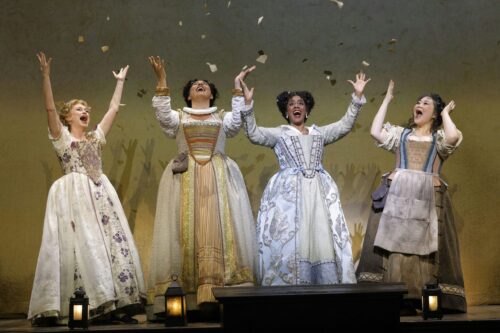
Along with Heaston, the merry wives – Meg Page (Sarah Saturnino), Nannetta (Deanna Breiwick) and Mistress Quickly (Hyona Kim) – were enthusiastic conspirators, intent on teaching Falstaff a lesson for his identical love letters to both Alice and her friend Meg. When their quartet mingled with the male quintet led by Alice’s jealous husband (Ernesto Petti), Verdi’s famous ensemble was in excellent hands. Petti’s silky baritone and good looks were a perfect foil to the slovenly Falstaff, enhancing the comedy by showing the absurdity of Alice’s so-called attraction to Falstaff.
Breiwick as Nannetta was well cast, both dramatically and vocally. She projected the youthful glow and determination of a young girl in love. Her lyric soprano shone in duets with tenor Anthony León as her lover, Fenton, and she was bewitching in her aria as Queen of the Fairies, one of the most magical moments in the opera, which was ably supported by the delicate singing of the LAO Chorus. As Fenton, León’s tenor was pleasing in his Act III love song. Kim’s performance as Mistress Quickly contributed, in no small measure, to the humorous antics onstage. She wheedled and cajoled Falstaff and set the women’s schemes in motion. Her pliant mezzo-soprano as she sang ‘Reveranza’ to Falstaff’s condescending pose was a comedic highlight.
The cast also included a vivid and convincingly sung performance by bass Vinícius Costa as Pistol. His partner in deception was Yuntong Han as Bardolph. Nathan Bowles rounded out the cast, proving to be a tuneful Dr Caius.
The effective sets and costumes by Adrian Linford and the lighting by Pablo Santiago suggested Elizabethan architecture and attire and created a convincing storybook world for the action.
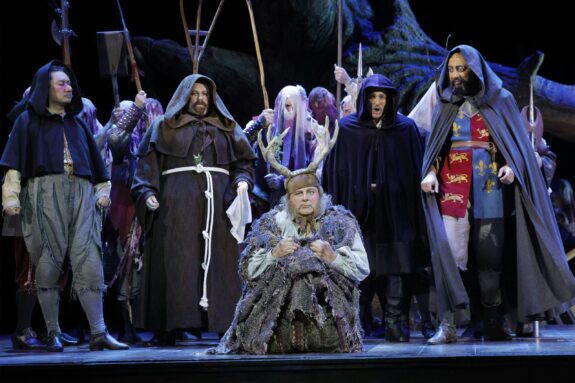
Whether dumped in the River Thames in a laundry basket and singing of the consoling power of wine or wearing antlers on his head and terrorized by the conspiring townsfolk, Falstaff retains his optimism in the face of adversity – perhaps a message from the 80-year-old Verdi.
In a final fugue, the company, led by Colclough, sang ‘Life makes a fool of us all’. Verdi’s life-affirming Falstaff nourishes the soul and proves, once again, the enduring power of art to move and enlighten.
Jane Rosenberg
Featured Image: Craig Colcough (Falstaff) with Yuntong Han (Bardolph), Nathan Bowles (Dr Caius), Ernesto Petti (Ford) and Vinícius Costa (Pistol) © Cory Weaver
Production:
Original Production – Lee Blakely
Director – Shawna Lucey
Sets and Costumes – Adrian Linford
Lighting – Pablo Santiago
Fight director – Andrew Kenneth Moss
Intimacy director – Sara E. Widzer
Chorus director – Jeremy Frank
Cast:
Sir John Falstaff – Craig Colclough
Alice Ford – Nicole Heaston
Ford – Ernesto Petti
Nannetta – Deanna Breiwick
Fenton – Anthony León
Mistress Quickly – Hyona Kim
Meg Page – Sarah Saturnino
Bardolph – Yuntong Han
Pistol – Vinícius Costa
Dr Caius – Nathan Bowles