
 ‘The Edge of the Abyss – The Music & Legacy of Sofia Gubaidulina’: Infrasound Ensemble / Yoshi Weinberg (artistic director). St. Malachy – The Actor’s Chapel, New York, 30.8.2026. (DS)
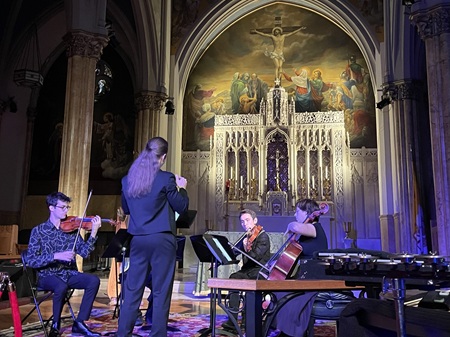
Gubaidulina – Selections from Galgenlieder; String Quartet No.2; Ein Engel; Garten von Freuden und Traurigkeiten; So sei es
While music asserts a reliance on melody and harmony, the composer Sofia Gubaidulina proves that it also opens portals to other dimensions. Hence the title of Infrasound’s three-day festival celebrating her chamber works was quite appropriate: ‘The Edge of the Abyss’. Director Yoshi Weinberg (also the group’s flutist) put it best in calling upon the audience to let the ‘cosmic ecstasy’ of her compositions ‘wash over and transport’ us. For me and probably for the audience (given their deep sighs and fervent applause), it certainly did.
In a final performance at the Times Square Actor’s Chapel (where medieval icons of saints dedicated to the arts hang over votive candles), they performed a sequence of Gubaidulina’s works with pulsating expression. While some pieces on the program were excerpted – like two songs from Galgenlieder whose floating islands of sound were performed with poignant elegance by mezzo-soprano Sophie Delphis – other works were presented in full. New-music interpreter David Bloom conducted the String Quartet No.2 without pause to help the players weave together the delicate and varied timings demanded of each complex entrance. They dramatically executed a gradual buildup of emotion that started with planar sounds that gently evaporate, to gibbering textures and screeches and on to an ecstatic blending of sounds that elevated the work beyond the material wood of the instruments – greater dimensions unlocked!
Infrasound’s concept for the festival revealed more than the spiritual power of Gubaidulina’s blend of classical and modern idioms. I discovered two standout points: her striking approach to the end of a work and a bold frontier for the double bass voice.
In the duet Ein Engel for contralto and double bass, the two opposing voices oscillated in touching sounds across a wide range of unexpected registers – the contralto part, sung with clarity by Luke Paulino, deepened while tentatively grasping textures associated with high pitches as the double bass, played by Sam Zagnit, entered a sonic space of high whimpers and beckoning harmonies as often as it dug, strenuously, into the low registers. Gubaidulina stretched the breadth of possibility for the double bass – doing for the instrument what Brahms did for the viola. Zagnit approached his parts with a mixture of focus and athleticism.
In the final two works, Gubaidulina’s unique endings crystallized for me, as if she nudges in a surprise coda from a back door. The musicians intrepidly plunged into the magical experience of Garten von Freuden und Traurigkeiten for harp, flute and viola complete with atmospheric green lighting. The experimental sounds that mixed with playful figures created a fairy tale maelstrom that was riveting, especially in the acoustics of a grand church. Then suddenly all musical sound stops: a short narration spoken by two of the musicians in German and English closes the work, as if departing the magical to return to the human.
The final piece, So sei es (composed in 2013 and the most recent on the program), also landed with an ending that sounded like an epilogue to this work of momentous shifts among four players. Pianist Daniel Schreiner and percussionist J Clancy lock together as the violinist and double bass drop out. In the coda-like reflection, they held long tones tautly and tapped short, pixilated sounds in rapturous partnership, seeming to pull the work back to the outer dimension from whence it came.
Gubaidulina’s works can range from the strenuous to the simply chromatic. It is how the musicians approach each one that triggers the special alchemy that bursts them into existence. Infrasound’s musicians proved to be the chemists who could activate these 20th-century potions.
Daniele Sahr