 United States Verdi, Macbeth: Soloists, Chorus and Orchestra of the Metropolitan Opera / Yannick Nézet-Séguin (conductor). Performance broadcast live (directed by Gary Halvorson) from the Metropolitan Opera, New York, 17.10.2026, and seen at the Everyman Cinema, Chelmsford, 19.10.2026. (JPr)
Seen and Heard International had already reviewed the Met’s season-opening new Macbeth before I saw this Live in HD and there is little to disagree with in Edward Sava-Segal conclusions (click here). My focus is mainly on my reaction to Lise Davidsen’s stage debut as Lady Macbeth. I was one of the first to champion the Norwegian soprano’s obvious promise more that a decade ago following her success in Operalia 2015 (click here). Sadly, there is increasing evidence (to me at least) that she is not reaching the soprano heights in repertory other than Richard Strauss possibly, but Wagner definitely. The issue is that while Davidsen has a wonderful technique and an imposing stage presence she is not developing into a great actor-singer. Just think about how much better the two leading actor-singers of this generation, Anna Netrebko (review here) and Asmik Grigorian (review here), have been as Lady Macbeth in the past.
Premiering in 1847 Macbeth was Verdi’s tenth opera, his first Shakespeare one, and better ones were still to come when he wrote it; and even if the opera had the greatest-ever performance it can never be on a dramatic par with a version of Shakespeare’s play seen in the theatre or on TV. In my earliest opera-going days I saw Macbeth several times at Covent Garden and English National Opera but less often after 1990. The Macbeths included Sherrill Milnes, Renato Bruson, Jonathan Summers, Željko Lučić, and some Lady Macbeths – apart from Netrebko and Grigorian – were Grace Bumbry, Renata Scotto.
It is clear Verdi was striving for a greater sense of flowing music-drama with Macbeth and in tackling a play by his beloved Shakespeare he felt able to try something new. In the relatively short opera – about 2½ hours of music – there is much stirring music though Macbeth basically still is just one set-piece (monologue, duet or ensemble) followed by another. Writing to his librettist Francesco Maria Piave he announced ‘This tragedy is one of the greatest creations of man! If we can’t do something great with it, let us at least try to do something out of the ordinary’.
When we first meet Lady Macbeth, alone on the stage she reads aloud a letter from Macbeth telling her what the witches had prophesied. Shakespeare has her worrying about her husband’s weakness which is something she intends to deal with as she plots the demise of Duncan, the Scottish king. Verdi turns this scene into a tour de force for all Lady Macbeths, the first of several. After an urgent, ominous orchestral introduction, the soprano intones the words of the letter, before she launches into a resolutely dramatic recitative, culminating in a portentous high C, then plunging – mimicking the dagger that is soon used against the king – into chesty low notes full of menace. Lady Macbeth begins the famous aria ‘Vieni! t’affretta!’ and even though, as to be expected, Piave’s words are more clichéd than Shakespeare’s, Verdi’s music is conspiratorial, manipulative and compelling leaving no question as to who ‘wears the trousers’ in her marriage.
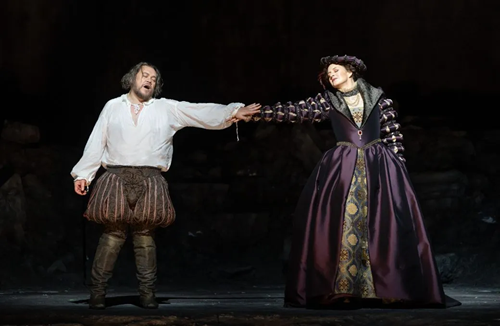
From Lise Davidsen there were all the notes, if not entirely with the vocal ease Verdi requires. However, if the best acting is reacting, throughout there was precious little – I am sorry to say – from her and little obvious (sexual) chemistry between Davidsen’s Lady Macbeth and Quinn Kelsey’s Macbeth whose performance was on a much higher level. Davidsen’s sleepwalking scene was not the dramatic high point it must be and anyway this Lady Macbeth looked as she had just come from the beauty salon.
Like a Met predecessor, Željko Lučić, Kelsey has a world-weary physicality and voice ideal for the character. His slightly weary, grainy baritone has an eloquent legato when necessary; as well as tremendous reserves of power and – unlike Davidsen – Kelsey acted Macbeth very convincingly. In the pivotal ‘dagger scene’ when he emerges with his hands and shirt covered in blood after dispatching King Duncan in his sleep, Macbeth turns to his wife in desperation as if he has had an out-of-body experience. He seems unable to grasp what is happening to him …and why. One blood-soaked act leads to the next until Kelsey’s Macbeth is a broken man with a fragile grasp on reality. In the final two acts this Macbeth was clearly someone on a pre-destined path he had absolutely no control over. Compared to Kelsey, the other singers with more than most to do – as well as the magnificent, stentorian chorus, witches apart – mostly just sang out into the auditorium with little apparent direction from Met debutant Louisa Proske.
Apart from Duncan’s murder and the sleepwalking scene, the opera also gives us Macbeth’s encounters with the witches, the banqueting scene (here featuring some odd dancing) and Macbeth’s descent in madness, and the battle that culminates in the strangest of all musical moments – a tenor duet(!) for Macduff and Malcolm. Thrown into the mix are Lady Macbeth’s second-act aria and a La traviata-like brindisi.
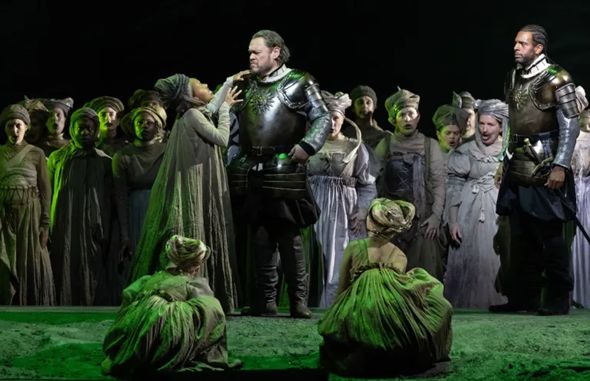
Apart from Adam Silverman’s too gloomy lighting, Louisa Proske minimalist production and Jon Bausor’s revolving set seemed designed for the cinema. There is an (over-familiar) apocalyptic landscape for the witches (or succubi) feeding off dead soldiers on Shakespeare’s desolate ‘blasted heath’, or derelict private apartments, or mirror-panelled reception rooms in Macbeth’s cheerless, castle or palace. It would have all appeared even more oppressive had there not been quite so many people on the stage, witches (Shakespeare’s ‘weird sisters’) especially. They were described by Bausor (in a filmed segment) as the ‘protagonists of fate’. They are not ever-present but seen more often than they usually are, sometimes swishing their skirts, sometimes crackling manically. Montana Levi Blanco’s 16th-century costumes have Kelsey looking like Henry VIII and Davidsen as Elizabeth I at one point.
Bausor referenced how ‘Macbeth is a play about war, it’s about destruction’ and described how his mise-en-scène has ‘a lot of concrete within the show, it’s a cold material, but it also colourless; it sits there dark and can be anything, it’s a backdrop for the colour, the blood, and the things that are spilt on top of it’. Continuing how ‘With this production we really wanted it to be fast and wanted it to be succinct. It’s a show that goes from domestic to epic within seconds. You’re suddenly in a banquet, then you’re in a bedroom, and then you’re on a heath, it’s almost filmic I’d say. So, the set is revolving deliberately to take us from one place to another. It’s an action thriller in that respect.’ So, this gives an idea of what was seen dimly on the stage ‘Through a glass, darkly’ (the Bible, not Shakespeare).
Verdi’s Macbeth is essentially a two-hander, yet nevertheless, Ryan Speedo Green was an impressive Banquo and his typically splendid ‘Come dal ciel precipita’ in the second act, prior to his murder, made me wish Verdi had given the character substantially more to sing. Having even less to do was Jonathan Burton’s Malcolm and he did his best. Freddie De Tommaso got one of the biggest ovations for an ardent, forthright ‘Ah, la paterno mano’, as Macduff laments the death of his children and expresses a determination to bring about Macbeth’s downfall. This grief-laden, suitably rousing aria leads to the vow Macduff makes with Malcolm to free the people from the tyranny of the Macbeths. All the smallest parts were sung with distinction.
Ably supporting the singing was Yannick Nézet-Séguin who appeared to relish the duality of Verdi’s uneven score which veers wildly from an eerily dark and supernatural atmosphere to a depiction of a poisoned world and ends with a patriotic chorus. Nézet-Séguin conducted his wonderful Met Orchestra dynamically and with attention to detail in an authoritative account with forward momentum driving the drama inexorably towards its tragic conclusion.
The performance was dedicated to the memory of Martina Arroyo who died on 13th October; Ryan Speedo Green (who worked with her as a young artist) eloquently paid tribute, ‘Ms. Arroyo was one of those astounding artists who understood that it’s not just having a beautiful voice that makes you a great opera singer, it’s the work, it’s the dedication … She was the epitome of that and one of the greatest gifts she gave me, and so many others, is the belief we belong on these stages … As a person who grew up never imagining having a career at the Metropolitan Opera, having someone of her stature take notice of me and my voice, and helping me with my career, it was priceless … We can honour her and her legacy by continuing to help open those doors for the artists who are now coming up behind us.’
Jim Pritchard
Featured Image: Quinn Kelsey (Macbeth), Ryan Speedo Green (Banquo) and witches © Marty Sohl/Met Opera
Cast included:
Macbeth – Quinn Kelsey
Lady Macbeth – Lise Davidsen
Banquo – Ryan Speedo Green
Macduff – Freddie De Tommaso
Malcolm – Jonathan Burton
Lady-in-Attendance – Marcy Stonikas
Physician – Bradley Garvin
Manservant – Jeongcheol Cha
Fleance – Tāwhana Smith-McDaniel
Creatives:
Production – Louisa Proske
Set designer – Jon Bausor
Costume designer – Montana Levi Blanco
Lighting designer – Adam Silverman
Choreographer – Jorrell Lawyer-Jefferson
Action director – Ran Arthur Braun
Chorus director – Tilman Michael
Live in HD Host – Anthony Roth Costanzo