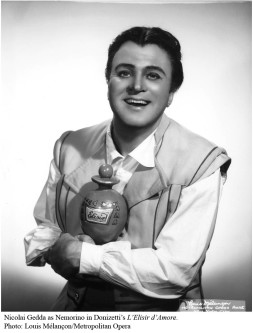
Nicola Gedda as Nemorino one of his signature roles
His daughter, Tania, announced the death of Nicolai Gedda on January 8 at his residence near Lausanne, Switzerland. His death occurred a few months after that of his first wife, the pianist Nadia Gedda-Nova – Tania’s mother – and a few days after that of Georges Prêtre with whom he collaborated several times, notably as Don José in the recording of Carmen alongside Maria Callas.
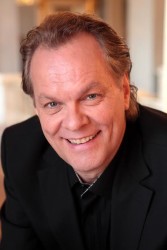
Michael Volle one of the leading baritones on the international stage today is a recipient of eminent German Theatre Award ‘Faust’ and in 2008 and 2014 was named ‘Singer of the Year’ by opera magazine ‘Opernwelt’. In a 2008 interview with Jim Pritchard for Seen and Heard, Volle had yet to sing Hans Sachs a role which has since established him as one of the greatest acting baritones of his generation. A pinnacle of Volle’s career was singing Sachs in Stefan Herheim’s production of Die Meistersinger at the Salzburg Festival 2013.
Alexander Karpeyev in Conversation with Robert Beattie
Alexander Karpeyev (c) Julian Dyson
Alexander Karpeyev has been a major prizewinner in a number of international piano competitions including first prize at the 2007 Dudley International Piano Competition. He studied at the Moscow Conservatory and with Joan Havill at the Guildhall School of Music in London. He is a noted exponent of Medtner’s music and recently defended his doctoral thesis on the performance practice of the music of Medtner at City University of London. Last year he organised the first International Medtner Festival in the UK and he is the curator of the Pushkin House Music Salon in Bloomsbury Square which showcases Russian chamber music. He recently gave a superb recital in Kings Place which focused on Russian music composed immediately prior to the Revolution of 1917 (review).
IndiaVarious composers: Maria José Siri (soprano), Simon O’Neill (tenor), Kai Rüütel (mezzo-soprano), Long Zhang (tenor), Andrea Vincenzo Bonsignore (baritone), Matteo Peirone (bass), Symphony Orchestra of India / Carlo Rizzi (conductor), Jamshed Bhabha Theatre, National Centre for the Performing Arts, Mumbai, 2.2.2017. (JSM)
Verdi – Overture to La forza del Destino; Otello (excerpts) Giordano – Andrea Chénier (excerpts) Bizet – CarmenSuites (excerpts)
India Puccini, La Bohème Revisited: Soloists, Symphony Orchestra of India / Carlo Rizzi (conductor), Jamshed Bhabha Theatre, National Centre for the Performing Arts, Mumbai, 8.2.2017 (JSM)
Fighting Back From What Life Throws At You And Inspiring Others: Jim Pritchard Interviews The Soprano Elisabeth Meister
Elisabeth Meister
One of the highlights of the recent concert performance of Die Walküre for the Saffron Opera Group was Elisabeth Meister’s wonderful Sieglinde. Peter Reed in Opera magazine described how ‘gathering depth and brilliance’ she ‘built towards an orchestra-surfing “O hehrstes Wunder!” of pulverizing grandeur’. On this site I said she just ‘got better and better’ and how ‘Meister is an intelligent singer who knows how to project her voice, and she achieved extraordinary heights of passion in Act III without pushing the voice beyond its limits.’ (For full review click here.) I also mentioned how Elisabeth was – with this performance – returning to singing after something of a hiatus to her singing career, which was set to have a meteoric rise after leaving the Royal Opera’s Jette Parker Young Artists Programme. Elisabeth has a remarkable – and inspirational – story to tell which involves losing and regaining her singing voice.
If one wanted a broad picture of the evolution of historical performance, with intriguing little nuances revealed along the way, there would be few better musicians to talk to than Monica Huggett. She has been an unremitting force for four decades, well known from her early association with the Academy of Ancient Music and the Amsterdam Baroque Orchestra, and these days as Artistic Director of the Portland and Irish Baroque Orchestras, and Adviser to the Juilliard Historical Program. This interview traces the violinist’s experiences from the time when the authentic movement was just gathering momentum. Most important are her insights about how historical performance has developed out of a number of contrasting approaches that have cross-fertilized each other. Equally interesting are her ideas on where historical scholarship and performance practice still have room to grow, what she wants to achieve from an orchestra in interpretation, and how she has maintained an undiminished inspiration all this time. The interview took place in conjunction with the Vancouver Bach Festival in August 2016, where Monica Huggett directed the Pacific Baroque Orchestra in the Complete Bach Orchestral Suites (review).
We use cookies to ensure that we give you the best experience on our website. If you continue to use this site we will assume that you are happy with it.